
Key Takeaways
- IO Tree’s devices have already reduced pesticide use by 30%, with a target to push that number further.
- The company operates across agritech and smart water management, with five live products and more in development.
- Lebanon serves as its R&D sandbox while the company eyes expansion into the GCC, Canada, and Costa Rica.
Overview
IO Tree is a Lebanese agritech company founded in 2019 and headquartered in BDD, with operations in Antelias. The company designs and manufactures IoT and AI-powered hardware devices aimed at reducing pesticide use, cutting water waste, and improving crop health. Its products serve farmers, NGOs, and agricultural operators across the MENA region and GCC.
The company was founded by Nisrine Turky, a computer engineer and academic who serves as CEO.
Background
Turky came to agritech not through farming but through engineering. A professor and researcher at AUB and LAU, she had already founded an earlier company — Electronis — which built boards to teach hardware and software automation, dating back to 2006. IO Tree followed the same logic: find a problem where technology can create measurable impact, and build a device around it.
Agriculture was an obvious candidate. The sector was underserved, dependent on chemicals, and largely untouched by modern sensing technology. Turky had no background in agronomy. She had a background in building things that work.
Mission and Approach
IO Tree’s stated focus is precision agriculture, giving farmers data they can act on rather than forcing them to rely on instinct or blanket chemical application. The company frames its work around three areas: pest detection, smart irrigation, and plant health monitoring.
Its philosophy is practical rather than promotional. Customer satisfaction, not sales volume, is how the company measures whether its products are working. In a market shaped by geopolitical instability, sales figures alone tell an incomplete story.
Products and Offering
IO Tree currently offers five live products across agriculture and water management.
Its flagship device, IO Tree, uses IoT and AI to identify pest threats before they reach crops. Farmers typically respond to pest risk by applying pesticides broadly, often at significant cost to both their health and their harvest quality. The device reduces pesticide use by 30%, with an ongoing target to lower that figure further.
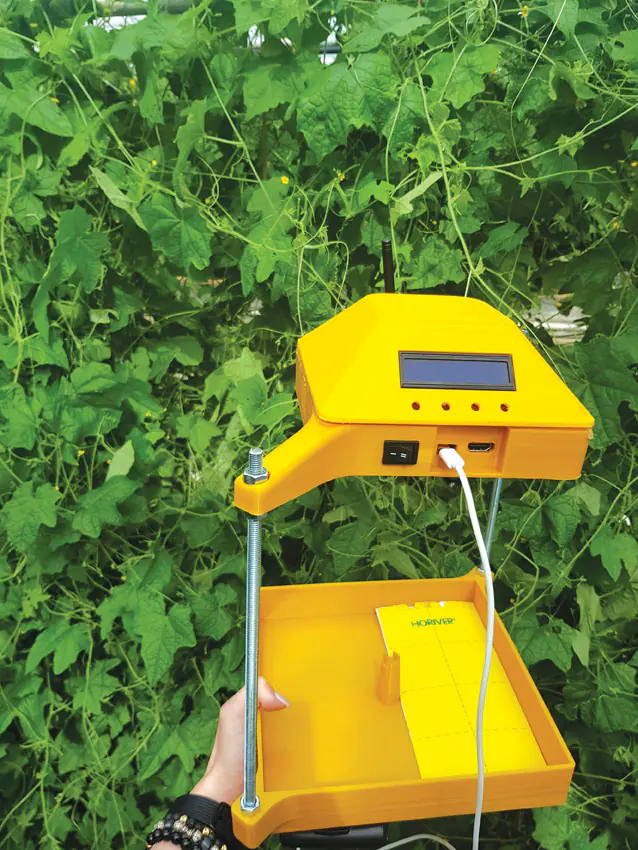
Aquatenta is a plug-and-play smart irrigation system combining multiple sensors with AI-driven recommendations. It tells farmers when and how much to irrigate based on crop type, soil composition, and available pump capacity. IO Tree Light functions as a micro-climate weather station, detecting early signs of plant disease before visible symptoms appear. The WM is a non-invasive, clamp-on smart water meter for residential use, monitoring household water consumption without requiring any modification to existing pipes. A fifth product focused on livestock — specifically reducing water usage on cattle farms — is currently in development.
Production relies on a small core team of seven, supported by continuous R&D. All products are live.
Business Model
IO Tree generates revenue through a combination of hardware sales and software subscriptions. Devices can be purchased as standalone units, providing basic monitoring data, or paired with a yearly subscription to Mazaateck, the company’s software platform, which delivers deeper analytics and actionable insights.
The company operates primarily through B2B and B2B2C channels. Its main customers are not individual farmers but entities already embedded in agricultural operations such as NGOs, distributors, and companies managing farm networks who then extend IO Tree’s products to end users on the ground.
Market and Reach
IO Tree operates within the agritech sector and targets the GCC and broader MENA region. Lebanon functions as a live testing environment, allowing the company to iterate rapidly on hardware and validate recommendations across real growing conditions.
The company’s international ambitions extend beyond the region. Turky appeared on Shark Tank and has identified Canada and Costa Rica as expansion markets, reflecting the global applicability of precision agriculture tools.
Funding and Support
IO Tree raised $65,000 in equity from Flat6Labs in 2019, in exchange for a 10% stake. The company has operated on a bootstrapped basis since. No additional external funding has been announced.
Traction and Growth
IO Tree describes itself as being in a growth stage, with new products still entering the market. The company’s clearest milestone to date has been breaking into the livestock sector, which is a notoriously difficult market to penetrate, with a device targeting water efficiency on cattle farms.
Customer satisfaction remains its primary metric. In a market where conflict and instability can distort sales data year to year, the company has chosen to anchor its performance indicators to product efficacy and user outcomes.
Misconception
IO Tree is frequently mistaken for an agri-engineering firm or a supplier of pesticides and fertilizers. The company’s position is the opposite: it exists to reduce dependence on those inputs.
Outlook
Over the next 6 to 12 months, IO Tree’s focus is on deepening its presence in the livestock sector, adding new electronic devices to serve that market. Lebanon will continue to serve as its primary testing ground as the company prepares to validate its model for international replication.